What Is Shadow AI and Why It's Your Biggest Risk in 2026
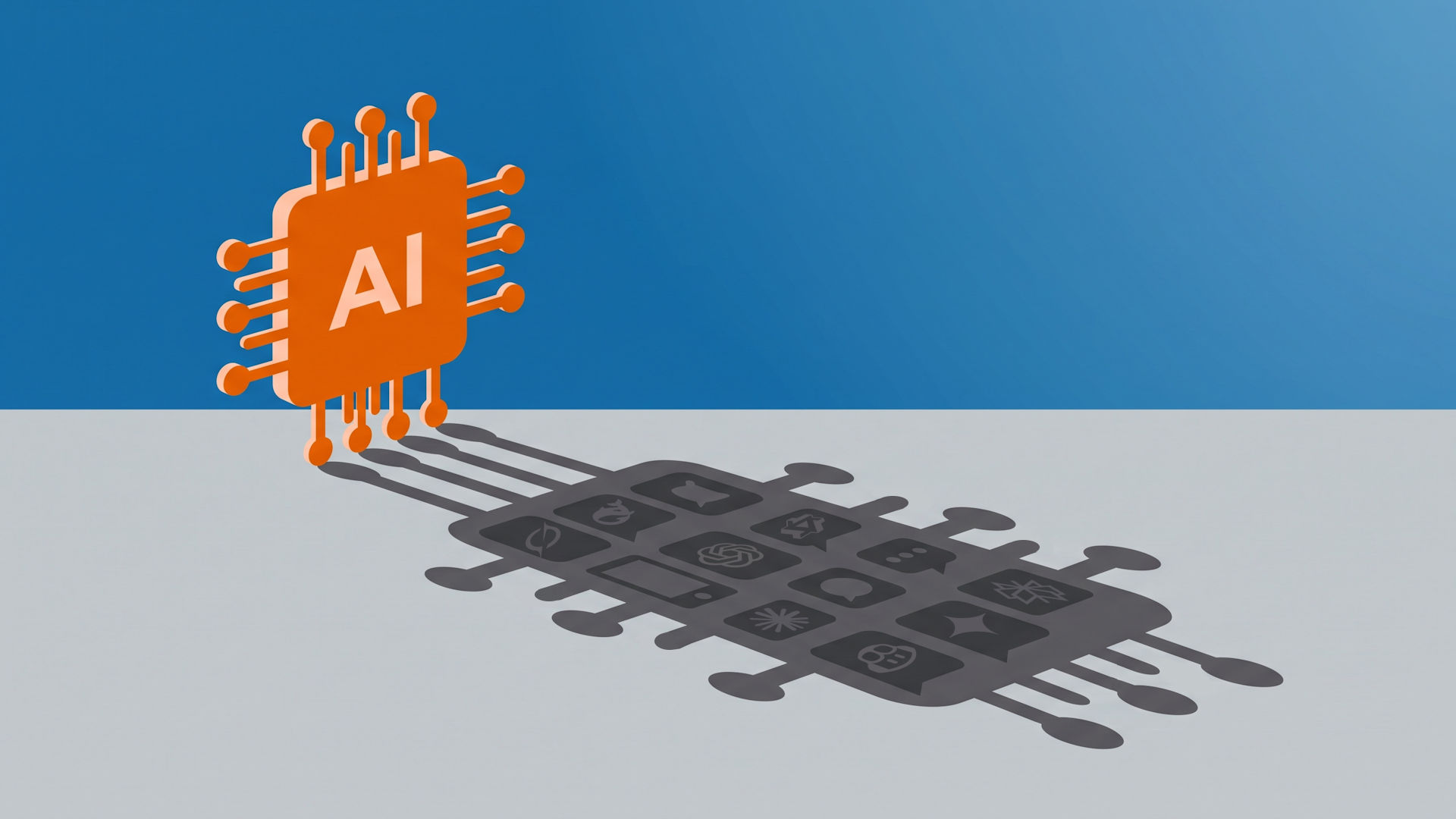
Workers at more than 90% of organizations regularly use personal AI tools for their jobs, while only about 40% of those organizations have an officially procured AI subscription, according to MIT Project NANDA's 2025 report, The GenAI Divide: State of AI in Business. If your business doesn't have a written AI policy yet, there's a good chance yours has a similar gap, and nobody has told you about it.
That statistic is worth sitting with for a moment. Shadow AI isn't a hypothetical risk you can schedule for later. It's very likely already running inside your business today, on laptops and phones you don't monitor, moving client data you don't know has left the building. And 2026 is the year this stops being a background risk and starts being a business-critical one. In April, delegates at the Liberal Party's National Convention passed Resolution 46014, calling for a binding federal AI law modelled directly on the EU AI Act: drafted this year, oversight bodies in place by 2027, and full implementation by 2028. The federal government's own $2.3 billion "AI for All" strategy, announced June 4, points the same direction: Pillar 1 promises "tighter accountability for AI used in hiring, lending, and automated decisions" for any business deploying AI tools, not just the ones building them. Insurers have already started asking for AI governance evidence before renewing policies, and agentic AI tools are taking actions without a human clicking "send." Every one of those pressures runs into the same underlying problem: you cannot govern a tool you don't know exists.
What shadow AI is
Shadow AI is any AI tool being used for work without your organization's knowledge or approval, whether or not the person using it means any harm. The word "shadow" doesn't mean someone is hiding something on purpose. It means the tool is invisible to whoever is supposed to be governing it.
It helps to compare shadow AI to the older, more familiar problem of shadow IT, the unapproved app someone installs to store files or manage a project. Shadow IT is a data location problem: your data sits somewhere you don't control. Shadow AI is a more serious problem, because the data isn't just stored, it's processed. It may be used to improve someone else's model, cached in a conversation log on a vendor's server, or reproduced, in some form, in an answer given to a completely different user later on.
Picture how this plays out in an ordinary week. An employee is behind on a deliverable and pastes last week's client meeting notes into a free AI chatbot to get a quick summary. Nobody told them not to, because nothing has been written down. It isn't malicious, and it probably isn't even unusual. But those notes, likely containing a client's name, contact details, and specific business information, just left your organization's control and landed on a vendor's infrastructure, under terms of service that nobody at your company has read.
That's shadow AI. It's rarely dramatic. It's just quiet, constant, and completely outside anyone's field of view.
At Evolutie, we build our entire approach to AI governance, what we call Intentional AI, around closing that gap. The first pillar of that approach is Intentional Selection: no AI tool enters your business without someone deciding, on purpose, that it belongs there. Shadow AI is what happens in the absence of that decision.
The scale of the problem in 2026
The numbers on shadow AI adoption are large enough that most small and medium-sized business owners underestimate them by a wide margin. MIT Project NANDA's 2025 research found that officially sanctioned AI subscriptions exist in only about 40% of surveyed organizations, while regular personal AI tool use for work shows up in more than 90% of them. If you think you know what AI tools your team uses, the honest starting assumption is that you're only seeing a fraction of it.
That gap isn't for lack of trying on the part of IT teams. A 2024 survey by ManageEngine, The Shadow AI Surge in Enterprises: Insights from the US & Canada, found that 85% of IT decision-makers confirm employees are adopting AI tools faster than security teams can assess them. The same survey found that 93% of employees admit to putting information into an AI tool without explicit approval to do so. This isn't a rogue minority. It's close to everyone.
The problem is also compounding quickly as businesses adopt AI agents, tools that take multi-step actions on their own rather than just answering a prompt. CrowdStrike's security services team has documented this gap directly: in two recent client assessments, it found hundreds of unaccounted-for AI agents running in production environments. In one case, the organization's own inventory of approved AI agents was roughly 400 agents short of what was actually in use. Neither business was unusually careless. They were simply typical of how fast agentic AI adoption is outpacing governance.
Palo Alto Networks' 2025 white paper on AI governance adds another data point worth knowing: 47% of organizations report specific concern about the security risks introduced by AI-generated code created through unauthorized, unreviewed channels. If your business writes any of its own software, internal tools, or automation scripts, this risk applies directly to you.
The five ways shadow AI actually costs you
It's easy to treat shadow AI as an abstract compliance concern. It isn't. In practice, a single ungoverned AI tool creates damage in five distinct ways, and one incident often hits more than one at once.
- Data exfiltration. Once sensitive data reaches an external AI tool, it may be logged, reviewed by vendor staff, or used to improve future versions of the model. There is no way to pull that data back once it has left your control.
- Intellectual property leakage. Proprietary pricing models, client deliverables, and internal strategy documents submitted to a consumer AI tool can be absorbed into that vendor's training pipeline. Once that happens, there is no way to recall it.
- Compliance violations. Under PIPEDA and BC's Personal Information Protection Act, using someone's personal information for a new purpose (like running it through an AI summarizer) generally requires consent specific to that purpose. An employee pasting client data into a consumer AI tool almost never has that consent in hand.
- Cost overruns. Different teams quietly subscribing to competing AI tools, none of it tracked centrally, adds up to real, unbudgeted spend with no oversight attached.
- Audit gaps. When an AI-assisted decision goes wrong, or a client asks how their information was handled, shadow AI leaves no record. You can't produce evidence of what data went where, because nobody wrote it down in the first place.
Catching these risks before they turn into incidents is the second pillar of Intentional AI: Vigilance. It's the ongoing discipline of watching for exactly this kind of damage, rather than discovering it after a client asks an uncomfortable question.
This isn't hypothetical
If the risk still feels abstract, consider what happened to Codeway, a Turkish software company, in 2024. Codeway's Chat & Ask AI App exposed approximately 300 million private chatbot messages belonging to roughly 25 million users after a database was left misconfigured.
What made the exposure so damaging wasn't the mechanism, it was the content. The exposed data was the actual messages people had typed into the app: private disclosures about financial hardship, mental health struggles, and family difficulties. None of it was meant for anyone else to see.
The lesson has nothing to do with Codeway's intentions. Every cloud AI service stores user inputs in some form as a normal part of running the service. That storage creates exposure the moment infrastructure is misconfigured, regardless of how careful or well-meaning the vendor is. If your business doesn't know which AI tools are in use, you have no way to know which of your own data might be sitting in someone else's misconfigured database right now, and no way to respond quickly if it is.
What to do about it
The good news is that closing this gap doesn't require a large compliance department. It requires five concrete moves, and they map directly onto the pillars behind Evolutie's Intentional AI approach.
- Build an AI tool inventory. List every AI tool in use across the business, including free consumer tools, embedded AI features inside existing software, and anything IT didn't procure directly. You cannot practise Intentional Selection on a tool you haven't written down.
- Write an acceptable use policy. Spell out which tools are approved, what kinds of data may never go into an AI tool (client personal information is the obvious starting point), and what verification is expected before AI-assisted work goes out the door. This is the plain-language version of what we call Disclosure: being honest with your own staff, and eventually your clients and insurers, about how AI is actually used in your business.
- Define a human-in-the-loop review step. Decide, in writing, which types of AI-assisted work require a person to check the output before it's used, and which lower-stakes tasks don't. This is Oversight: a human stays accountable for every AI-assisted decision, not the tool.
- Do basic vendor due diligence. Before approving a tool, check whether the plan you're using permits the vendor to train on your data. Enterprise and business tiers typically restrict this; free and personal tiers typically don't.
- Review it on a schedule, not when something breaks. Revisit the inventory, the policy, and the risk picture at least once a year. This is Continuous Evolution: the tools your team uses will keep changing, so the governance around them has to keep moving too, not sit in a one-and-done binder on a shelf.
Gartner projects that more than 40% of AI-related data breaches will result from improper, cross-border use of generative AI by 2027, and if Canada's promised AI law follows the EU's penalty structure, as Resolution 46014 proposes, violations could cost a business up to 7% of global annual revenue.
At Evolutie, we call this Intentional AI: deliberate selection, measured impact, ongoing vigilance, human oversight, honest disclosure, and continuous evolution. Shadow AI is what happens when none of those six things are happening on purpose. The fix isn't complicated. It just has to be deliberate.
Where to start
You likely already know, roughly, which AI tools your team talks about openly. The real exposure is in the ones nobody's mentioned. Evolutie's AI Risk X-Ray assessment is built on the Intentional AI approach described above: a structured review of what AI is actually running in your business, compared to what you think is running, with a prioritized list of what to fix first.
Do you know how many AI tools are running in your business right now? If you're not confident in the answer, that's the question worth answering before anything else on this list.
This article is general guidance, not legal advice. Consult a qualified professional for decisions specific to your business.
Sources: MIT Project NANDA, The GenAI Divide: State of AI in Business 2025 (July 2025); ManageEngine (Zoho Corporation), The Shadow AI Surge in Enterprises: Insights from the US & Canada (2024); CrowdStrike, Inc., Securing AI Systems: A Playbook for Security Leaders (2025); Palo Alto Networks, AI Governance: Building a Framework for Responsible AI Adoption (2025); Gartner, Inc., Gartner Predicts 40% of AI Data Breaches Will Arise from Cross-Border GenAI Misuse by 2027 (February 17, 2025); Liberal Party of Canada, Resolution 46014 (Canadian Artificial Intelligence Governance and Transparency Act), National Convention (April 2026); Government of Canada, "AI for All" National AI Strategy Announcement (June 4, 2026).